

As WMATA develops its “Better Bus” regionwide plan, a big question for residents along upper Connecticut Avenue is whether bus service really will be better: faster, more reliable, and more frequent. There’s a case to be made that Connecticut needs all of the above. But getting there will require more advocacy by the community.
Let’s look at the data. Jerry Malitz, in his October 2nd Chevy Chase News & Notes newsletter, published an analysis comparing Connecticut and Wisconsin Avenue between Upton Street and the DC line.
He looked at 2020 Census block data to determine that the blocks directly abutting on that length of Connecticut Avenue have six times the population of the comparable Wisconsin Avenue stretch (12,503 vs. 2,088). From the Census and other sources, he also found more services, more senior and low-income housing units, and more schools and recreation directly on Connecticut than the comparable stretch of Wisconsin.
Yet people heading to and from upper Wisconsin have twice the transit options, with two bus lines (the 31 and 33) and two Metrorail stations (Friendship Heights and Tenleytown). Connecticut between Upton Street and Chevy Chase Circle has one Metro station (Van Ness), and it is served by a single bus line (the L2). The WMATA Better Bus plan maintains this status quo, but does set out a goal of providing more frequent service on Connecticut, with buses arriving every 10 to 12 minutes on weekdays, and 12-minute headways on weekends. The L2 timetable, last updated in December 2022, has buses arriving every 10 to 30 minutes on weekdays, and 20 to 30 minutes on weekends.
WMATA, after collecting public comments through mid-June, recently released its final public engagement analysis. One interesting detail within the report is a map of bus lines productivity.
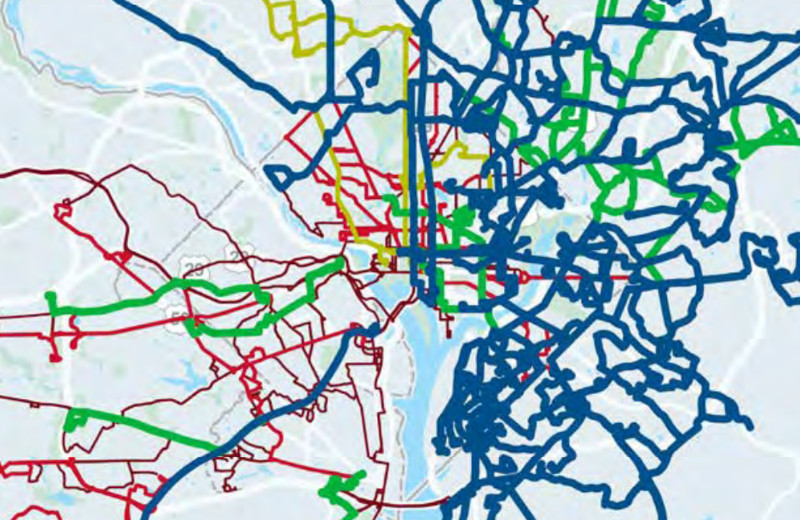
The lines in the eastern part of the metropolitan area have much higher productivity rates, which means these buses are seeing passenger loads that are heavy to bursting. Northwest DC, on the other hand has a dearth of bus lines, and they are not nearly as productive. The Better Bus analysis has two theories about bus lines with low productivity rates: The level of service is greater than the level of need, or the level of service is too low to attract riders.
The route to finding out
Steven Higashide, in his book Better Buses, Better Cities, lays out the winning formula: forward-looking transportation officials, and community advocates who are well-organized, understand transit and strategically push for better bus service. This includes good public outreach, and data collection and reportage by both parties.
The data coming out now show traffic patterns have changed. The Brookings Institution reported in September that with “…downtowns and office parks shedding so many daily workers who now stay home, local-serving businesses in neighborhoods closer to where people live are experiencing increased demand…. It’s also a clear signal that state and local practitioners should reconsider any expensive transportation projects primarily focused on funneling commuters in and out of office-centric neighborhoods, and instead focus on improving the accessibility and safety performance in and around those neighborhoods.”
What actions could be called “forward-looking”? Higashide gives as one example some pop-up bus-only lanes in the Boston area. “Over the course of a few weeks,” he writes, “city staff banned parking on a short stretch of road for a few hours of peak commute, used plastic cones, or red paint to mark the lane for buses only, and gathered data to see how the trial went.” These tests popped up around Boston, with the encouragement and support of community groups, and in some places, permanent bus lanes were installed.
A forward-thinking DDOT could try a pop-up bus lane on Connecticut Avenue, between Chevy Chase and Van Ness, to see if it increases “productivity” and gets more people out of their cars. Such an action would need a big push from community advocates.
This type of advocacy, from neighbors who bike and from DC cycling groups, proved its power when DDOT agreed to study bike lanes on upper Connecticut Avenue. Subsequent planning got the mayor’s approval. Buses have even greater potential for turning drivers into riders, and they also need advocates to organize and push for something better.
And maybe we can have both – better bus service and bike lanes – on Connecticut Avenue.
Discover more from Forest Hills Connection
Subscribe to get the latest posts sent to your email.