
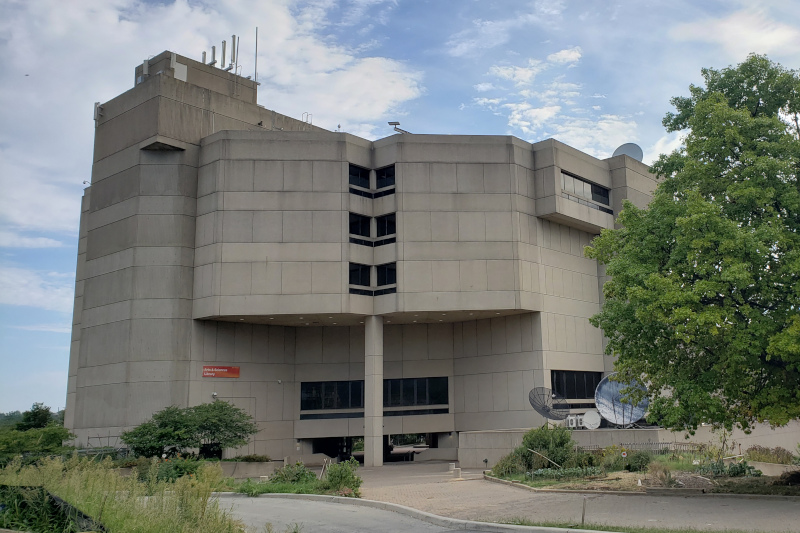
How did UDC’s Building 41 come to be selected as the future site of the DC government and historical archives? Why isn’t student housing being built there instead?
On September 6th, ANC 3F hosted a special meeting for “community clarification and discussion” to give critics and supporters of the archives project a chance to ask these and other questions of two of the university’s highest-ranking officials: General Council Avis Russell and Chief Operating Officer David Franklin.
Critiques have included UDC’s public engagement efforts. Russell gave an overview of the opportunities for community input during the creation of UDC’s 2020-2030 campus master plan. She also said the “transitory” nature of the student body may have made it appear like there was no effort to involve students in the process.
“It is conceivable that there were students who participated in that process in 2020 who are no longer students at the university,” said Russell, “but I assure you that we did receive input from students as well as the community.”
Russell also reiterated the options for Building 41 that had been set out in the master plan: That it be decommissioned as a UDC building and become the home of the DC Archives; rehabilitated and again be used for academics; or repurposed for use as student housing.
The decision, Russell explained, ultimately came down to funding. The DC mayor and the Council did not provide for building housing or otherwise rehabilitating Building 41. Instead, the District provided UDC the money for the lease and eventual purchase of 4250 Connecticut Avenue, which was needed for swing space as UDC worked to rehabilitate its aging buildings. A UDC official told Forest Hills Connection in 2018 that the university was “completely abandoning” Building 41, which previously housed the UDC library and the College of Arts and Sciences, “as we can no longer provide the proper environment for our faculty, staff and students.”
That left the archives as the next best option. “We think that this is a good alternative to having an empty building on campus” with no money for a renovation, Russell said. Demolition of Building 41 was not mentioned in the campus plan, she said, because project architects did not perform a site assessment until later. They determined that the structure was not strong enough. Archives officials have previously said the building would actually collapse under the weight of the collections.
“That is one reason that I understand it was decided to demolish it,” said Russell, “as well as the fact that attempting to renovate it would have been more costly than replacing it.”
Regarding housing, David Franklin, the university’s chief operating officer, said Building 41 was by no means the only option, and he said finding solutions and funding to meet this student need was his “number one goal.”
“We understand what it means to our students. We understand what it means to the faculty. We also understand what it means to the neighborhood: The more students you have on our campus it’s better for the residents in terms of the economy.”
Franklin said Buildings 46 and 44 have been considered as possible sites for housing. UDC also looked at acquiring the Van Ness Days Inn, and recently toured the former Intelsat/Whittle School building.
“So there’s a lot of conversations going on with with respects to housing,” Franklin said, “but all ties to funding, and without that funding it’s just very difficult to bring housing to the university.”
3F Commissioner Teri Huet asked about the preschool on the ground floor of Building 41. Avis Russell said the school’s memorandum of understanding “was scheduled to terminate in December of 2023, and so it will be leaving the site by that time.” Russell did not know where the CommuniKids, which has other area locations, was moving. But she said it had not been a campus amenity for students or staff.
“I in fact asked a colleague who had a toddler about using that center and she said that it was out of reach financially for her,” Russell said. She added that UDC’s Board of Trustees has discussed whether onsite daycare or childcare stipends would be better for students, as some prefer to find daycare closer to where they live.
Commissioner Huet was also among the attendees voicing strong support for the project.
“As a [former] student and as a parent whose son went to UDC, this archival plan is phenomenal,” Huet said.” It opens the opportunity for Master’s programs in library science… It allows student growth.”
Huet referred also to the power it could hold in transforming students’ lives, referring to an anecdote earlier in the meeting relayed by DC State Archivist Lopez Matthews.
“I have personally created three librarians,” Matthews said of his time at the Howard University archives, “by converting business students.” They were his interns, and he was able to show them “the power of working in libraries and the power of working in archives.”
Matthews also sees the DC Archives becoming an integral part of celebrating and recording UDC’s roots as a historically Black college and university (HBCU).
“Currently DC’s history is spread out among 18 different locations and this building will bring all of DC’s history back to the District,” Matthews said. That history includes the Civil Rights movement, the Black Power movement, and the creation of UDC.
Demolishing Building 41 and building the archives will require an amendment to the campus master plan. The Zoning Commission is holding a hearing on September 21st, and ANC 3F commissioners will be voting at their September 19th meeting on whether to lend their support to the amendment.
Discover more from Forest Hills Connection
Subscribe to get the latest posts sent to your email.