
More than a few of us took up walking the neighborhood last year to get some exercise and pass the time under shutdown orders. Mark Fitzpatrick did more than that. He turned up a number of hidden historical treasures on his walks around Tenleytown, AU Park, Forest Hills, Van Ness and North Cleveland Park. He first wrote about them on Facebook, and at his friends’ urging, he wrote a book.
Spies, Bombs, and Beyond: A Walking History of Washington DC’s Tenleytown is a collection of rich, eclectic histories of 70 sites in the area.
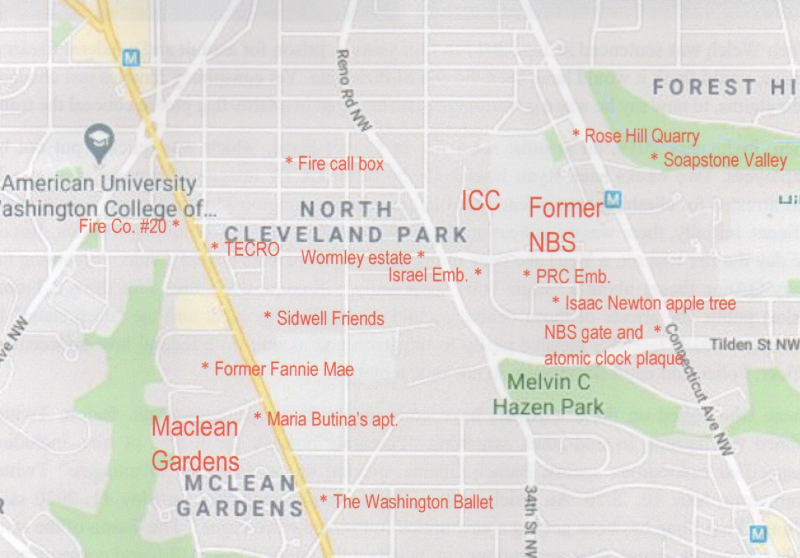
Fitzpatrick’s focus shifted to his Tenleytown/AU Park neighborhood and walking-distance destinations when Covid-19 curtailed his retirement career as a cruise ship lecturer on the politics and history of the cruises’ destinations. Before that, he spent 26 years as a U.S. diplomat and then was a director at a London institute, writing books about nuclear dangers.
Fitzpatrick tells Forest Hills Connection that even before the pandemic hit, the Tenleytown Heritage Trail had piqued his interest in local history.
One wonders how many pairs of shoes he has worn out exploring Tenleytown and uncovering local connections to famous figures including Charles Dickens, Henry Kissinger and Kermit the Frog, lesser-known luminaries including a Revolutionary War hero, and some infamous figures, such as the spies of the title.
Fitzpatrick’s favorite chapter is about Kim Philby, the famous double agent, and his connection to Tenleytown. Here’s an excerpt.
The Tenleytown Heritage Trail leaves out what I consider to be the most interesting story of the neighborhood. In September 1949, debonair British diplomat Harold Adrian Russell Philby, who went by the nickname Kim, arrived in Washington with his family to take up his posting as First Secretary. During his two-year tenure, they lived at a five-bedroom tan brick colonial at 4100 Nebraska Avenue.
Philby’s real job was Secret Intelligence Service (MI6) station chief at the British Embassy, liaison officer to the FBI, and to the newly established CIA. He was also a double agent for the Soviet Union, the most notorious of the infamous “Cambridge Five.” The top-secret US information that Philby gave his Soviet handlers resulted in the deaths of many brave men and women behind the Iron Curtain. Taking up residence in his basement was another of the five: Guy Burgess, an unstable alcoholic who also had a cover job at the British Embassy as information officer.
When another of the Cambridge Five, Donald Maclean, came under FBI suspicion, Philby worried that his own cover might be blown, so he drove off to a wooded stretch of the road near Old Angler’s Inn in Great Falls, Maryland and buried his Russian camera, tripod and film between the road and the Potomac River. It has never been found.
Mark Fitzpatrick’s Spies, Bombs, and Beyond is available on Amazon in paperback and Kindle editions. For more information, visit markfitzpatrickwroteit.com.
The article has been corrected. Mark Fitzpatrick was not “the director of the London Institute,” as we originally wrote. He was a director at a London institute.
Discover more from Forest Hills Connection
Subscribe to get the latest posts sent to your email.